Your shopping cart is empty!

+1 347-667-1633 | We Speak English & Español
webkitchenstore@gmail.com
0

Your Cart:
$0.00
Tofu Types and Tofu Recipe
Tofu, or bean curd, is a popular food derived from soya. It is made by curdling fresh soya milk, pressing it into a solid block and then cooling it – in much the same way that traditional dairy cheese is made by curdling and solidifying milk. The liquid (whey) is discarded, and the curds are pressed to form a cohesive bond. A staple ingredient in Thai and Chinese cookery, it can be cooked in different ways to change its texture from smooth and soft to crisp and crunchy.
The origins of tofu
Like many soy foods, tofu originated in China. Legend has it that it was discovered about 2000 years ago by a Chinese cook who accidentally curdled soy milk when he added nigari seaweed. Introduced into Japan in the eighth century, tofu was originally called Okabe. Its modern name did not come into use until 1400. By the 1960s, interest in healthy eating brought tofu to Western nations. Since that time, countless research has demonstrated the many benefits that soya and tofu can provide.
How to select & store
Tofu can be found in bulk or individual packages, both of which are refrigerated. Tofu is also sold in sealed containers kept at room temperature, which do not need refrigeration until they are opened. When opened, all tofus needs to be rinsed, covered with water and kept in a refrigerated container. To keep the tofu fresh for up to one week, the water should be changed often. If kept in the original package, you can freeze tofu for up to five months.
Given its neutral taste and range of consistency, tofu has an amazing ability to work with almost all types of flavors and foods. Extra firm tofus are best for baking, grilling, and stir-fries, while soft tofu is suitable for sauces, desserts, shakes and salad dressings. Of course, it is up to you to experiment! Try slicing, marinating and grilling it or chopping it up into smallish pieces and frying it with garlic until golden. Silken tofu is a creamy, softer product.
Contains Antinutrients
Like most plant foods, tofu contains several antinutrients
These include:
- Trypsin inhibitors: These compounds block trypsin, an enzyme needed to properly digest protein.
- Phytates: Phytates can reduce the absorption of minerals, such as calcium, zinc, and iron
Prep Methods
- For Eating Raw: Pretty straightforward. Soft and silken tofu is ready to go right out of the package (though, technically, any tofu can be eaten raw). Drain off the excess water, and eat up!
- Draining/Blotting: For block tofu, I like to slit the package and drain out the packing water. At a minimum, all tofus (except the silkens—more on them in a minute) should be drained by placing them on an absorbent surface, such as layered paper towels or a dish towel. Often five to 10 minutes will suffice; use this time to assemble your other ingredients.
- Pressing: This is the most common prep step in most tofu recipes. A block of medium to extra-firm tofu is sandwiched between dish towels (waffle-weave towels work best!) or paper towels. Place a flat surface on tops, such as a dish or baking sheet, and weigh it down with a heavy item (28-ounce tomato cans are extremely well suited for this job).
- Salt-Soaking and Draining: If pressing seems too complicated, you can bypass that step with a 15-minute soak in salt water. I was introduced to this technique through Andrea Nguyen's book Asian Tofu. She promotes it as a way to pre-season the tofu and create a crispier crust and texture. The soaking is followed by draining the tofu on a dish or paper towel.
- Freezing: You can just freeze a whole block of tofu, but it's convenient to cut it into the sizes you want beforehand. Almost all the moisture will be pulled out, compacting the curds and extracting the way, leaving behind a spongy product that greedily absorbs sauces. Frozen tofu can be defrosted in the fridge or microwave, or tossed into boiling water—boiling may sound counterproductive, but after freezing, the curds are so compact and the water pockets so enlarged that liquid drains freely from the tofu with a gentle squeeze. I find it's best to drain and/or press the tofu first, or else you'll end up with a huge ice block.
- Marinating: One of the biggest myths about tofu is that it soaks up the ingredients around it. This is only true with hyper-porous frozen tofu. Unless you have six hours to sous-vide the tofu and completely transfuse the internal moisture content, don't expect a lot of flavor from a marinade. This myth was publicly busted in Deborah Madison's book This Can't Be Tofu! To glaze, pan-fry the tofu—with or without oil—until golden. Then add a marinade, so that the fried exterior soaks up the flavors and the heat of the pan reduces the sauce to a clingy syrup.
The Best Tofu Recipe
- Prep Time :20 mins
- Cook Time:5 mins
- Total Time:25 mins
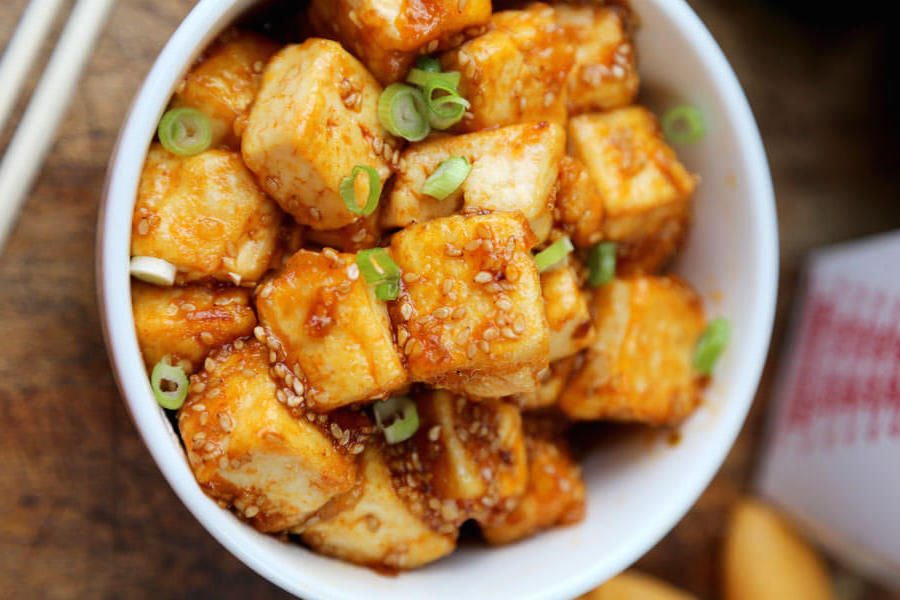
The best tofu recipe is marinated in simple pantry ingredients and also happens to be vegan and gluten-free.
Course: Main Course
Cuisine: Asian
Keyword: best tofu recipes, tofu recipe, tofu recipes
Servings:
Calories: 110 kcal
Ingredients
- 14 ounces extra firm tofu drained, pressed, and sliced into about 24 squares
- 3 tablespoons low-sodium soy sauce or tamari
- 1 1/2 tablespoons lemon juice
- 1 1/2 teaspoons pure maple syrup
- 1-2 teaspoons sriracha
- 1 teaspoon garlic powder
- 1 tablespoon coconut oil
Instructions
In a medium bowl, combine tofu, tamari, lemon juice, maple syrup, sriracha, and garlic powder, stirring gently to coat. Let marinate 15-20 minutes, stirring gently once or twice.
Heat coconut oil in a large cast iron skillet over medium heat. Once hot, add tofu and fry 2-3 minutes per side until crisp and golden. Add any leftover marinade to the pan and cook, stirring, one minute more.
Remove tofu from the pan and serve as desired.
Search
Categories
Popular Posts






Comments: 0
No comments